
Wednesday, October 24, 2012

Hip hip hooray... I'm 1kg today!


Seems like it was only last week when I first saw my lil joeys, they were so small, weighing only 200gms. I remember how they could both fit in my cupped hands. 

In those early days, looking after my little ones consumed a big part of my day to day, with bottle feeds at 12am, 6am, 12pm and 6pm as well as a normal days work, there's little energy for much else... Thankfully our favourite pass-time seemed to be snoozing on the couch together.

But that was 800gms ago, gone are the two little fragile joeys that spent the majority of their time either asleep or curled up in their pouches…

Make way for the two mini devils, full of beans who can't stay still longer than 10 seconds and spend every minute exploring my lounge room and kitchen and constantly rumbling each other.

It is just amazing to watch them play fighting and vocalising with each other, learning and developing skills that will so important in later life.

In the last few days I have been weaning them away from a bottle to lapping milk from a saucer, main reason being that as their teeth are now developing they keep biting through the latex nipples. No wonder the mother devil weans them around this time in the wild... Awwch!

They have also started eating solids now on a daily basis.

I usually feed them a mince mix around 7pm and they can smell the meat being prepared and usually go crazy. If I've been foolish enough to not be wearing socks at this time, which I usually am, they start to nibble my toes while waiting, quite a funny site as a friend pointed out to me the other day.

Now I know what you’re thinking... Do little devils have a cake with such an important celebration?

Well not exactly, but they did enjoy a nice size devil patty :)
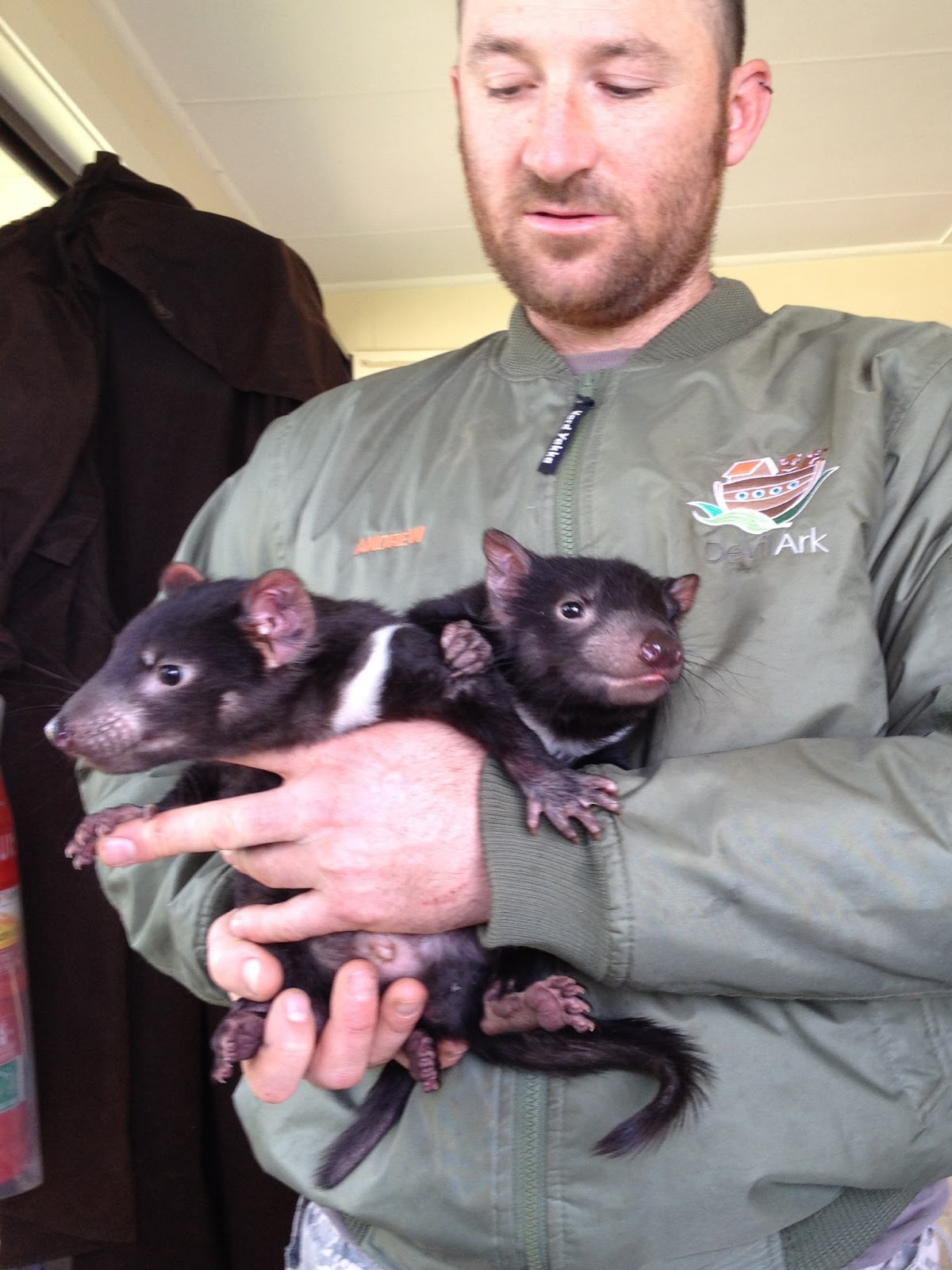
This is now ...

And that was then ... 6 weeks ago

Thursday, September 13, 2012

Month one of raising little devils


Any keeper will tell you that the highlight of their job is watching young animals growing up; and sometimes we are even lucky enough to lend a hand in this process…

 “After a hard day’s work...the little ones are all fed and snoozing by the fire...the hum of the washing machine can be heard and soon a load of pouches and towels will be hung out to dry...with a glass of red in my hand I contemplate a nap before our next feeding time”.

Raising young ‘ens can be hell, but for these little angles it’s well worth it!

Following such a successful breeding season and bearing in mind that captive bred devils could well be the saviour to prevent the extinction of the Tasmanian devil, Devil Ark has decided to assist wean and hand rear joeys of special genetic importance.

My two little devils were removed from their mother who had four joeys, a very full pouch and a heavy burden! So we waited until these two where approaching an age of independence and we started assist weaning them. This happens around an age of 120 days - when joeys are in and out of the pouch and often can be seen on the mother’s back.
 Assist weaning is something we try and do with females with four joeys. It gives mum some relief and helps her to recover faster. As you can imagine, one joey can be hard enough to look after, let alone four clinging to your back! In a few months these two will be returned to an enclosure with their siblings so they can learn to be little devils.

When I first had my little charges they weighed around 200grams and have short thin coats and rounded features. The male has a white stripe on his chest and is black all over. While the female has a broken white stripe on her chest, and stripes across her shoulders and tail base and black all over. These are the markings they will retain for the rest of their lives. For the next few months they’ll spend their time in and out of my ‘pouch’ which consists of a combination of beanies and knitted sacks and towels (made from cotton or wool – nothing artificial).

They are currently being bottle feed using a special marsupial milk replacer. This was initially every four hours round the clock. Fortunately their tummies gradually grew and I could increase the feeding volume and thankfully the time in between each feed expanded to every six hours.

They sure love their tucker! When I wrap them up and put bottle to their mouth they greedily drink.
One month on and their fur has thickened and features have sharpened, they really look just like mini devils now. Starting out at 200grams they weigh almost 500grams now. They are growing well -putting on weight every day. They are also quite mobile now, and before a feed love nothing more than a good chase and rumble - all important behaviour that will be necessary in their adult lives. Like all young though, they can’t help but to fall asleep once with a full belly of milk.
regular weigh ins to ensure appropriate weight gains
A bonus of this hand rearing is the opportunity for people to ‘meet’ and interact with these beautiful animals. Often it changes people’s attitudes when they come face to face with a ‘real’ Tasmanian devil. I have heard many people say things like “they are so much softer than I expected”; “oh they don’t smell after all”; “I thought they would be mean”. Having hand reared animals allows everyone to appreciate them as much as we do. And every convert counts!

Over the course of the next few months I look forward to bringing you more stories about my hand rearing adventures. The joeys will start be getting up to more mischief as they are introduced to solid foods. They already have developed a habit of stealing socks and stashing them behind the fridge!
Finally we do request your help please. We are seeking special people to adopt one of our 32 joeys. The little female I’m raising was recently adopted at the Gloucester Platypus festival and we are just waiting on her new adoptees, six year old twins Evaena and Nathan, to name her.

Now we just need the rest of our joeys to find generous ‘adoptive’parents. If we act together we can save the devil.

See you at the next festival.

Monday, August 6, 2012

The long waiting game is over - devilish joey success


After months and months of not always so patient waiting, we are excited to say that the 2012 breeding season at Devil Ark has been a huge success.


Last year we produced 26 joeys and this year we have counted 32 joeys!

The joeys currently range in size from little pink jelly beans, to fully furred mini devils. With such a strong result, it must be said that conditions for these animals are as close perfect as can be provided.

It was mid-February when we first noticed signs of reproductive behaviour, the most obvious was devils not eating their food - remember these animals are largely scavengers and will gorge feed, eating as much as one third of their own body weight!

Usually the devils will only leave behind chewed bones, if anything, so when we started noticing whole food items being left we knew the breeding season had started.

As a marsupial (non-placental mammal) the Tasmanian devil has an extremely short gestation period, around 19 - 21days. On average 20- 30 tiny joeys no larger than the size of a grain of rice are born; and four tiny joeys could fit on top of a five cent coin. After birth the joeys must make their way into the safety mum’s pouch.
joeys at approx 80 days
The Tasmanian devil is an extremely competitive animal and this behaviour starts right from birth. Of the 20- 30 joeys that are born, only a maximum of four will survive (the mother only has four teats in her pouch). What we’re seeing here is survival of the fittest right from the word go! Only the strongest four with the best instincts will make it into the pouch, latch onto a nipple and continue to develop.

The reason we have different age groups of joeys as not all females birthed at the same time. The age difference is around three months.

Female devils can cycle three times (usually 55 days apart) during a breeding season. This is known as 1st, 2nd and 3rd oestrus cycles.

Once the joeys are too big for mums pouch (usually at around 4 ½ months) they will be left in their burrow, which has a nest right at the end with rotting plant material to keep the little joeys warm. Devils are great diggers and burrows can be over two metres in length, going down on a slight angle for over a metre.

Devil joeys are usually well weaned by eight months and will disperse from the maternal burrow not to long after. These animals do not live in family packs or mobs and will live a solitary life only coming together for carrion feeding and breeding.

Like proud parents, Devil Ark keepers watch females with tails and back legs hanging out of ever stretching pouches, we can’t wait to have an up close look at the next generation of Tasmanian devils.
approx 100 days - joeys are now covered in a fine layer of velvety fur

Friday, July 27, 2012

'Doc' gives devils the thumbs up!


'Doc' gives devils the thumbs up!


It seems only yesterday that we were separating the first lot of Devils bred here and placing them into their own FREs (free range enclosures)... Three months on and its time for our quarterly heath checks.

This is a very exciting time, as it’s not only the juveniles, but all our devils that we check. Breeding season is likely over, some females starting as early as March so were expecting to see lots of little joeys in mums pouches. It also gives us the opportunity to see animals that are more secretive.


Although trapping is only done once every three months (to minimise human contact) we still observe our devils daily at feeding time, using game cameras or just out and about doing their thing. If an animal is seen with an injury or poor health at any time, we will always have a closer look and take appropriate action.

Our health check starts with every devil in a FRE being trapped. The special traps we use are designed for devils and are made out of plastic, this minimises the risk of injury as well as exposure to the elements. They are also nice and dark to avoid excess stress.

The devil is transferred from trap to a hessian sack, has it micro-chip read for identification, is weighed, visually checked over and treated for external and internal parasites. All observations and information is recorded on the animal’s personal health sheet, and after checking the devil’s history it is released back into its enclosure.
weighing
recording details

 All in all, we are very happy with the condition of our devils!

The juveniles breed last year are looking fantastic and all putting on good weight. On average female are weighing 4.5kg – 5kg and males weighing 6.5kg – 7kg

As expected there are a few wounds amongst the adults, mainly the males. But as this species is very competitive and aggressive during the breeding season, these are nothing that we were surprised to see, or be overly concerned about.
about to be released after a thorough health check
The most common injury for a male is bites to the tail base and rump, showing fur loss at the site.
All wounds are treated as we process each devil. Devils also have an amazing immune system and in my time working with have been amazed how quickly they heal. Adult females weighed 7.5kg- 8kg and adult males weighed up to 10kg.

We were very excited to see lots of little joeys of various ages, some no bigger than a jelly bean in mum’s pouches, and are looking forward to the next health inspection when we will be able to have a closer look.
 joeys approx 80 days old

Saturday, June 30, 2012

Winter at the Ark

Just when it seemed that autumn was going to last forever, there can be no denying that winter is well and truly here! Most mornings we are either greeted by a harsh frost or an eerie mist, and a few weeks ago we had our first light snow. Thank goodness for thermal underwear! 
A picture says 1000 words
 But we can’t complain as weatherwise we had an outstanding April and May. To think that only a few weeks ago we were working in t-shirts, shorts and sporting singlets on that extra sunny day. The last few weeks though, the temperature has plummeted. Now you won’t find me without anything less than two layers on and even my dog wears her winter jacket.

Just the other morning while waiting for the kettle to boil (ummm coffee) I noticed steam coming out my mouth and nose, and this wasn’t outside, it was in my house. Now that cold!

And it’s not only the temperature that’s diminishing, but also the photo opportunity period. Barrington winter sunrise is at 6:53am and sunset at 4:58pm, compared to summer sunrise at 5:48am and sunset at 8:02pm. Thank heavens winter solstice has now past!

A positive of this however is the increased keeper observation in devil activity, as devils like to use the cover of darkness to move about, feed and get up to all sorts of mischief!
For those of you familiar with a heavy morning frost, you’ll agree that visually, it’s nothing short of beautiful. 
Frozen blades of grass and muddy puddles crunching under foot and frosty crystals that cling and coat everything... including our vehicle windscreens.

In fact there have been a few mornings where cars either haven’t started, or have taken what seems like forever to warm up. Putting water on the windscreen to break up the ice only to have it re-freeze seems a bitter irony. Other problems we have to deal with work-wise are partially frozen water bowls, frozen water lines and the endless job of cutting and splitting firewood.
Our first snow, which was only a light dusting started at around 9pm and lasted a few hours. Excitedly I ran to my car and drove for around for 20 minutes hoping to find a decent deposit for a photo, but it wasn’t enough to hold and had evaporated well before morning as we also had a rain that night. This was only to be a sneak peak of what’s to come as the area Barrington Tops is renowned for its winter whites.

Now I know what you’re thinking…  what about the poor devils, they’ll be freezing up there! Well it’s very important to remember that these animals’ wild habitat of Tasmania is very cold, in fact it’s one of the reasons the Barrington Tops was selected, our long term goal will be breeding and maintaining a healthy population of devils whose descendants will eventually repopulate the Tasmanian ecosystem, not only do we need devils with wild behaviour, but also animals that can cope with the harsh, cold weather conditions. Cradle Mountain (NW Tasmania and home to wild devil populations) experiences winter temperatures this time of year with an average morning of 2 degrees, and an evening temp of -2 degrees (and 7 degrees at midday).


Happy winter all!
Andrew, Devil Ark Keeper

Tuesday, February 14, 2012

It's Valentine's Day and love is in the air at Devil Ark!

Love doesn’t get much better than this!

Following our first successful breeding season at Devil Ark last year, our next season is almost upon us.

The female Tasmanian devil’s body has already started to prepare for mating, which will start later this month. The skin around her neck is thickening (ready for a few “love bites”) and her pouch is deepening to accommodate her new joeys.

Is this what love at first sight looks like?
Hen and Conan meet for the first time... we know their off sping will be cute!

Mating occurs over a seven day period after the female selects her mate. If she doesn’t fall pregnant with her first ovulation, she can have two more cycles before the end of June. Devils aren’t monogamous so she could have many partners if not defended by the male. He ‘mate guards’ by sprawling across the entrance of his mate’s den to prevent other unwelcome male visitors.
 Her skin is thickening...


Gestation is a brief 21 days, after which around 30 tiny devils are born. Since mum only has four teats, it is a race for the first four to fuse themselves to her teats to survive. They will feed from their mother for six months before venturing from their den in Spring.

These juvenile devils will become fully independent by December. Last year’s Devil Ark babies are now in a crèche and will be moved into free range enclosure when they reach breeding age next year.

Devil Ark’s first breeding season last year was a great success with 26 baby devils born at Devil Ark - the largest number of devil joeys ever born in captivity. Devil Ark has quickly become the largest breeding facility for the endangered Tasmanian devil and we are now home to almost 100 devils in large free range enclosures that mimic the natural landscape of their native Tasmania.

With the insidious DFTD (Devil Facial Tumour Disease) now reaching the final disease-free area in Tasmania’s North West, extinction in the wild seems inevitable. This highlights the importance of Devil Ark’s goal to preserve this fascinating marsupial.


Friday, December 23, 2011

Population swells

Devil Ark now officially has 93 Tasmanian devils making us the largest conservation breeding program on the mainland! This is great news for the long-term survival of the devil.

Yesterday the arrival of ten more Tasmanian devils at Devil Ark has swelled our population and genetic pool just in time for the next breeding season that starts in February.


Some of the devils released yesterday are from Tasmania where they have been in quarantine for up to two years to ensure they are disease-free and others are from mainland zoos.

It’s a busy time at Devil Ark; we have just received breeding recommendations from ZAA (Zoo and Aquarium Association) and the stud book dictates which devils should be configured together for the impending breeding season which starts in February.

During the next few weeks, teenage devils (those who have reached reproductive age) will be transferred from their crèche enclosures at Devil Ark where they will be arranged into breeding groups of between six and eight.

And the 26 joeys born in the first breeding season at Devil Ark will be weaned and moved into the crèches vacated by the teenagers.

The growth at Devil Ark is very timely as recent news reports from Tasmania have brought the terrible news that the fatal DFTD (Devil Facial Tumour Disease) has infiltrated the western half of the state and in particular the north-west, which was the Tasmanian devils’ last stronghold. The areas were believed to be free of the devastating disease that is propelling the Tasmanian devil towards extinction and now sees more than 84% of the wild population destroyed.

Devil Ark Operations Manager Tim Faulkner believes “This could see the whole state of Tasmania left with between just 1-5% of devils in as little as two years.”